
Wow!!
What a day!!
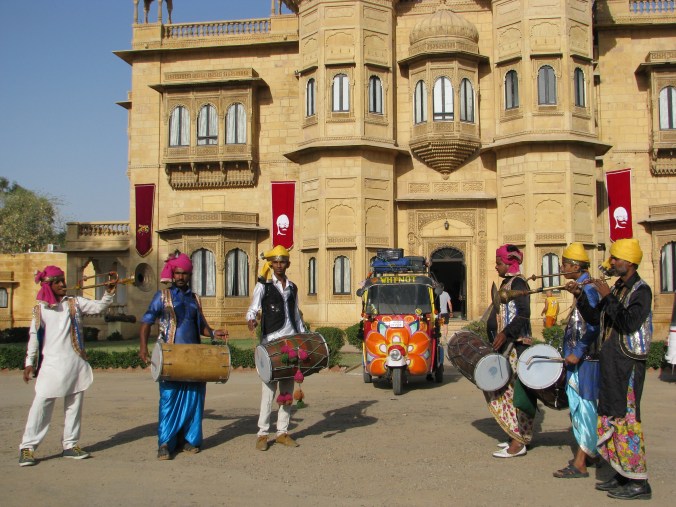
We woke up and headed to the starting line at the Jahawar Nigas Palace and prepared for blast off!
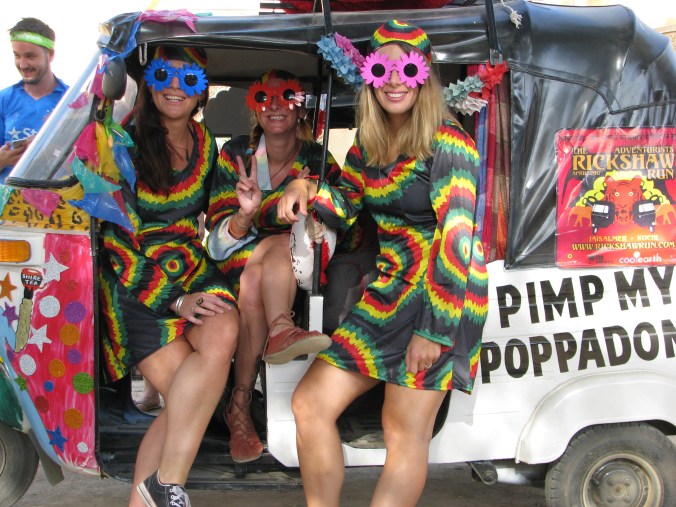
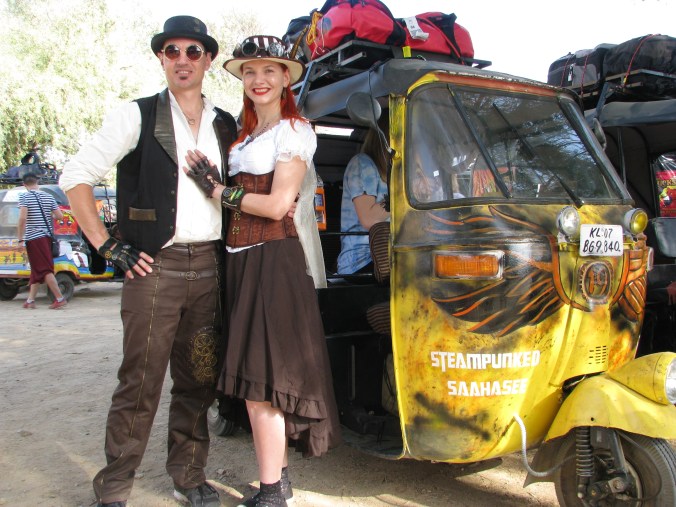
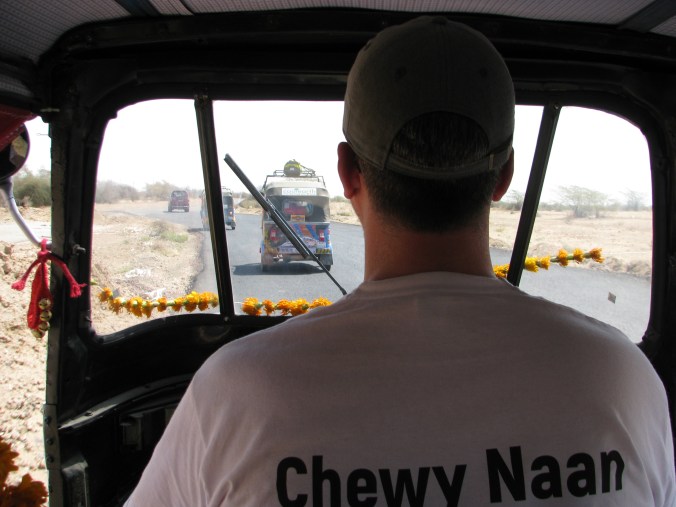
There were 85 rickshaws in the “race”. Every single rickshaw was pimped out. Almost every rickshaw rider was pimped out.
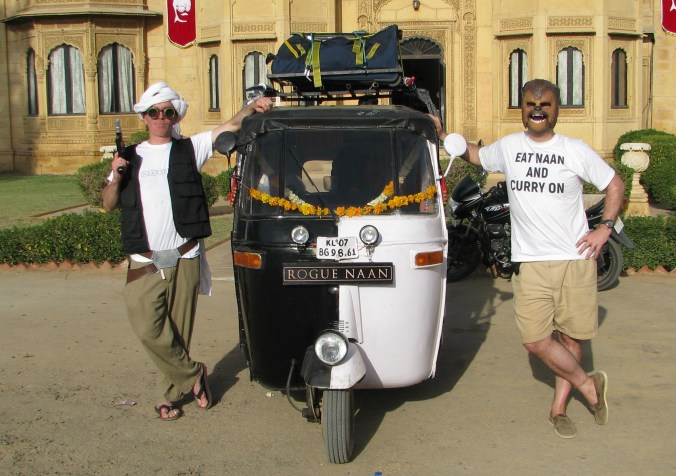
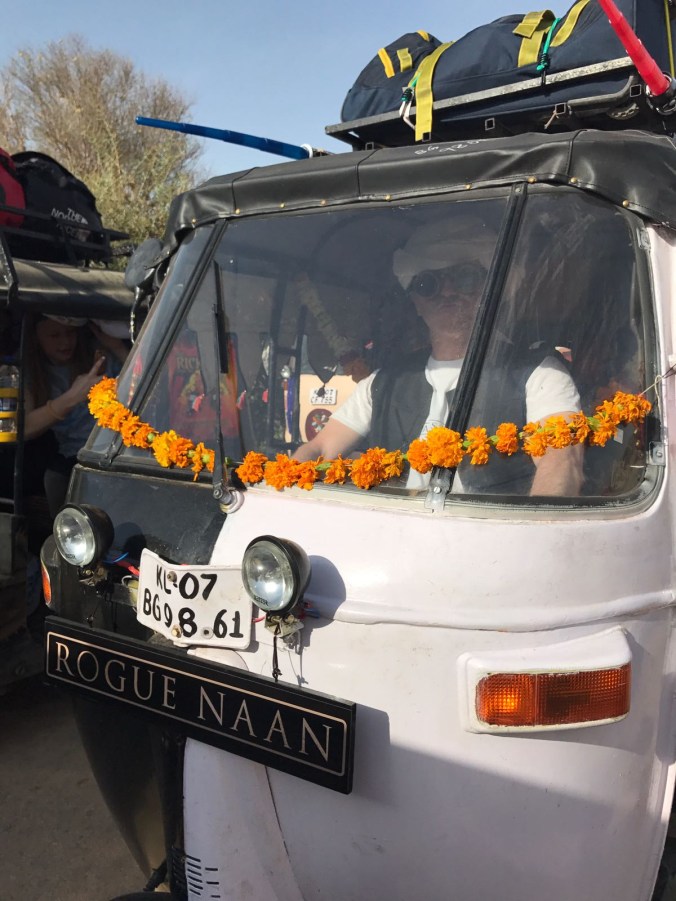
We had a team of Elvises, disco dudes, a firetruck tuk tuk (complete with working siren and working mini firehose with pump), a slightly confused looking goth-ish couple, a team of bears (In 105F heat! Way to think that one through, guys) and, of course, Rogue Naan…
There was fantastic carnival, party, festival atmosphere (and, I’m sure, a few people who were a little freaked out about driving a used lawnmower 3,000 kilometers across India).
The organizer gave everyone a brief speech about driving in India, which went more or less like this: The rules of the road in India are pretty simple. Basically, there are no rules.
And he was right.
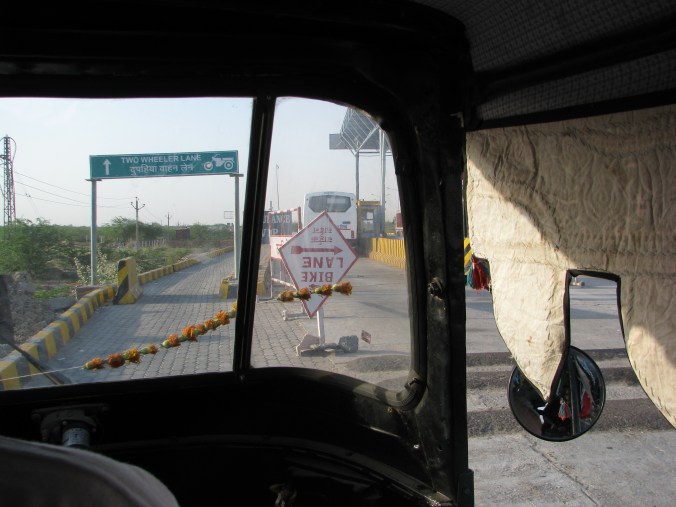
There are no stops signs. No stop lights. No street names. No road signs (except for some very confusing ones that no pays any attention to).
One such sign seemed to suggest you are allowed to go backward on the road, but not forward. Some signs are conveniently fixed upside down, which, when they have arrows trying to point you in a specific direction, can be very confusing.
There is, in fact (as we learned), one rule of the road. That one rule is the ranking order of priority for the things you most commonly encounter on the road.
Cows first
Buses second
Then trucks
Goats
Dogs
Pigs
Cars
Tuk tuks
(Technically, scooters rank lower than tuk tuks)
Very often, all of the above (plus more) are on a given road at any one point in time, so it’s critically important to know where you rank in the order and to follow the rules strictly.
If you are a tuk tuk and you give a scooter the right of way at a roundabout, you are very likely to get creamed by a bus and people will generally all stand around and agree that it was most definitely your fault.
After our ‘in-depth’ morning briefing at the starting line, there was a ceremonious drum & horn jam played by local musicians and we were unleashed in a chaotic parade out onto the open road to cross India.
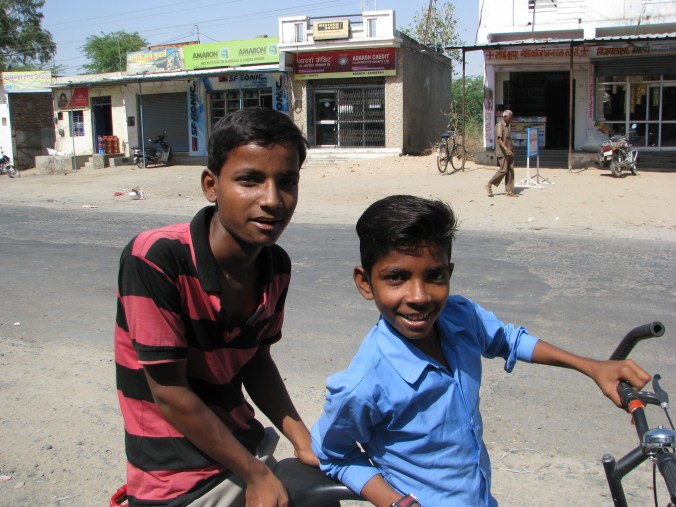
Everywhere we go, people wave and smile.
Everywhere we stop, we are greeted as if we are the most wonderful aliens from outer space (and to be fair, that’s probably what we look like).
We frequently draw crowds of people interested to know “what is your name”, where are we from and what the heck are we are doing.
When we stopped for lunch and parked our rig outside the roadside restaurant, a man walked past our rig, stopped, wobbled his head and read our sign with great curiosity (and a bit of confusion), “Ro-ghee Naan… hm.”
He examined the sign as if he was thinking, ‘I have not tried this ro-ghee naan. It must be from the south…’
Almost immediately on the road, we learned that horn is the almighty communicator.
People honk their horn for all reasons – and no reason.
Horn means everything including: “hello”, “I’m passing you on the right”, “I’m passing you on the left”, “I’m right behind you”, “don’t you dare cut in front of me”.
Trucks have wonderfully musical horns. Buses have horns that shake your innards.
If a bus honks, it typically does so only when it’s so close up your backside that you have to check your underwear. It’s a pretty jarring experience and it definitely happens too late to do anything, even if you could.
Approximately 42.7% of all vehicles have the following bumper sticker… “Horn Please”
They like horn. They want horn. They need horn.
Without a horn, you are hopeless.
About half way through our first day on the road, we lost our horn.
Kaput. Nada. Niente. Zip. Zilch.
There really aren’t too many people in the desert of Rajasthan who can fix a horn. So, we did the only thing we could do when we needed horn… we yelled horn.
Goat on the road… “HORN!!!!”
Dog… “HORN!!!!”
Camel… “HORN!!!!”
You need these things on the road to know you’re coming (and to move, if possible), but obviously, yelling horn at everything on the road is an unsustainable solution.
When we arrived in Jodhpur, we soon found a mechanic on a crowded side street. Upon arrival, we were greeted by more or less everyone on the street.
While Eric talked to the mechanic about horn, I was given a tour (with most of the street watching) of what can only be described as the most blinged-out, chavtastic Rolls Royce of tuks tuks. Painted yellow with shiny chrome everywhere, the inside was a temple of fantastic-ness: a horn that sang, impeccable velour seats, strobe lights, two fans and a stereo capable of filling the Royal Albert Hall with perfect sound.
The owner of the Rolls Royce tuk tuk let loose his speaker system with Indian dance music. I shook my arms in the air in a mock dance move and the 30 people surrounding the tuk tuk went bananas. Everyone raised their arms in the air and copied my “dance move”. Soon, I found myself in a full-fledged dance party on a side street of Jodhpur.
Meanwhile, Eric and the mechanic fixed the problem and gloriously we regained horn (and lights, which also weren’t working). I gave as many participants of the dance party a good old American high five and off we went to find a hotel.
In total, we made it about 340 km in our first (totally amazing) day! It may not sound like a lot, but in a 7hp power glorified lawnmower fully loaded with two men, bags and 2 spare petrol tanks, that’s a lot! It took about 10 hours!
 Rogue Naan